


A Complete Guide to Seal Design: Essential Materials for Seals!
2021-08-12
I. An O-ring is a sealing element with a circular cross-section. It is widely used in various mechanical equipment and plays a sealing role under certain temperatures, pressures, and different liquid or gaseous media. Compared with other seals, it has the following superior performance:
①. The sealing part structure is simple, the installation part is compact, and the weight is lighter.
②. It has a self-sealing function, and often only one sealing element can complete the sealing effect.
③. Good sealing performance, almost no leakage when used as a static seal, and only some leakage when used as a dynamic seal at higher speeds.
④. The dynamic friction resistance is very small, and it can also adapt to occasions with pressure changes.
⑤. The size and groove have been standardized, the cost is low, the product is readily available, and it is easy to use and purchase externally.
Compared with other sealing rings, there are also the following three problems:
①. Large starting friction.
②. When used as a pneumatic device seal, lubricating oil must be added to prevent wear.
③. The processing dimensions and accuracy requirements of mating parts, such as the moving surface, groove, and gap, are very strict.
Structural design principle of O-ring
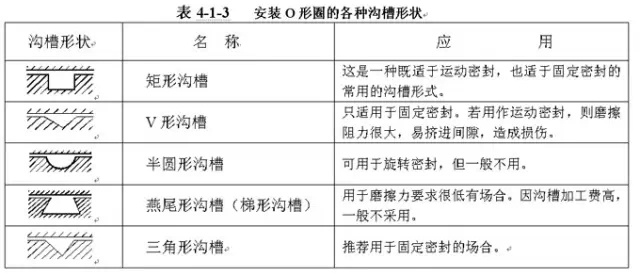
Because O-rings are installed and used in various grooves, the installation groove conditions are listed in Table 4-1-3.
Pressure and sealing gap
O-rings are generally sealed by the rebound generated by compression, but as the pressure increases, they are squeezed into the sealing gap and change shape, as shown in Figure 4-1.
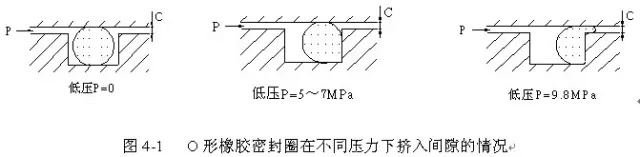
In order for the O-ring to have a good sealing effect and extend its service life, the gap between the O-ring installation groove and the sealing part must be properly designed. When the gap is too large, the O-ring is squeezed into the gap under the action of oil pressure, causing damage and thus causing leakage. When the working pressure is less than 9.8Mpa, generally no retaining ring is designed. When the pressure is greater than 9.8Mpa, the pressure-bearing surface of the O-ring is easily squeezed out, and a retaining ring should be added; if the pressure is unidirectional, a retaining ring is set on the pressure-bearing surface, and if the pressure is bidirectional, two retaining rings should be set, as shown in Figure 4-2.

O-ring execution standard
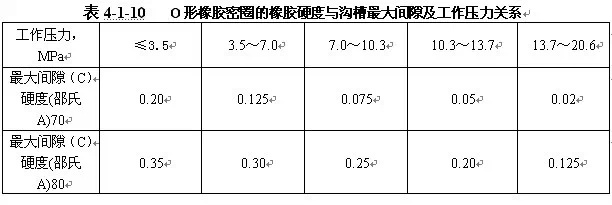
Relationship between O-ring hardness, maximum groove gap, and working pressure
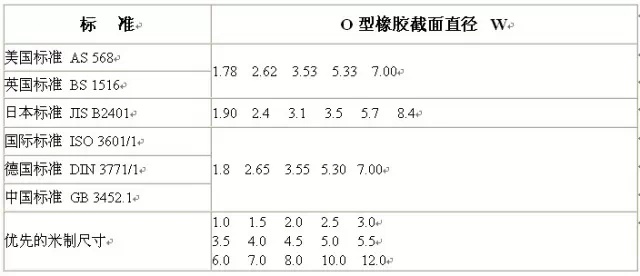
The relationship between the size of the sealing gap, pressure level, rubber hardness, and the diameter of the O-ring cross-section is shown in the table below:
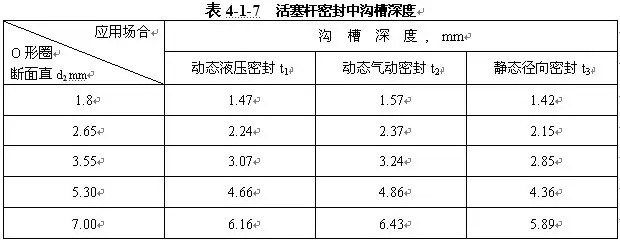
Groove depth in piston rod seal
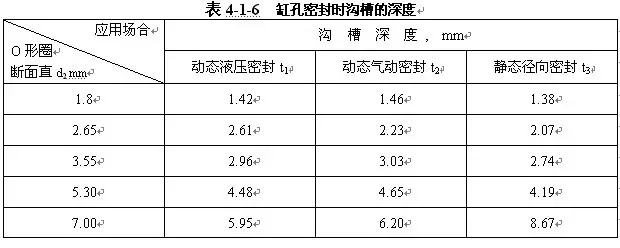
Depth of groove when sealing cylinder bore
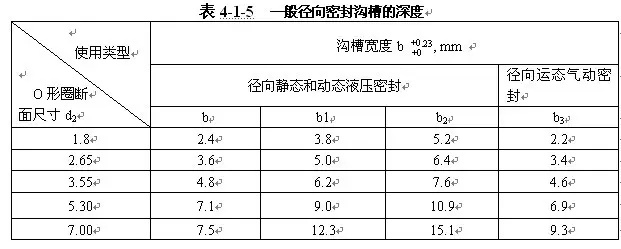
Depth of radial sealing groove
General radial sealing groove width; see Table 4-1-5
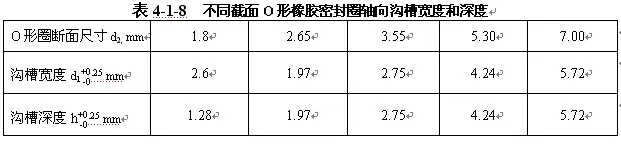
Axial groove width and depth of O-ring with different cross-sections
Axial sealing groove width and depth; axial sealing groove width and depth see Table 4-1-8
Relationship between hardness of O-ring rubber material and working pressure
In rubber material standards, hardness and compression set are the two most important properties. Choosing a rubber material with less compression set is beneficial to sealing performance, while hardness is crucial for the pressure resistance and anti-extrusion of O-rings. According to domestic standards and practical experience, the compression set of rubber at a specified temperature does not exceed 50%. The hardness of the rubber is closely related to the sealing working pressure. The higher the pressure, the higher the hardness; see Table 4-1-11.

Note: The working pressure of rotary motion generally does not exceed 0.4 Mpa, and the hardness is selected at (70±5) degrees; if it exceeds 0.4 Mpa, it should be designed according to special sealing devices.
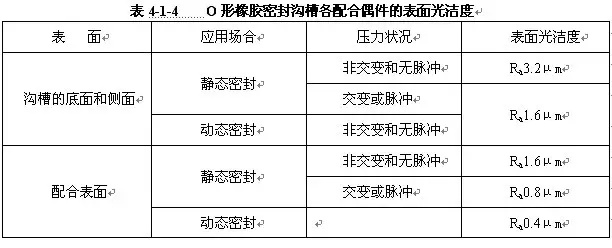
Surface finish requirements of the groove
The surface finish of the groove and the roughness of the groove contact surface have a great impact on the sealing effect and durability.
Surface finish of each mating part of the sealing groove
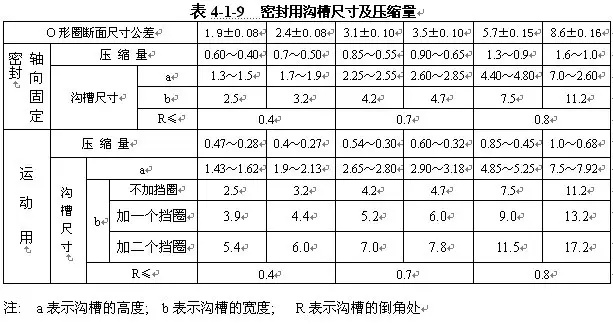
Groove and compression
The compression rate of O-rings for static sealing is generally 15~25% (this data is empirical data). For dynamic sealing, such as reciprocating motion, the compression rate is 10~12%, and for rotary motion, the compression rate is generally 3~5%. The common compression amount of O-rings and groove dimensions are shown in Table 4-1-9.
Previous:
Other news
Quick Quote.
Please tell us your needs, and we will recommend suitable products for you.
How can we assist you?
How can we help you?
If you are interested in our products, please leave your contact information

Built into China with
Competitive and influential new materials enterprise


Copyrights©2025 Guangdong Meirun New Material Technology Co., Ltd. Powered by CEglobal